
Denver's Electric Streetcar Legacy: Shaping Urban Mobility and Future Transit Innovations |
From 1888's Streetcars to Modern BRT Systems, Denver Continues to Evolve Its Public Transit Infrastructure |
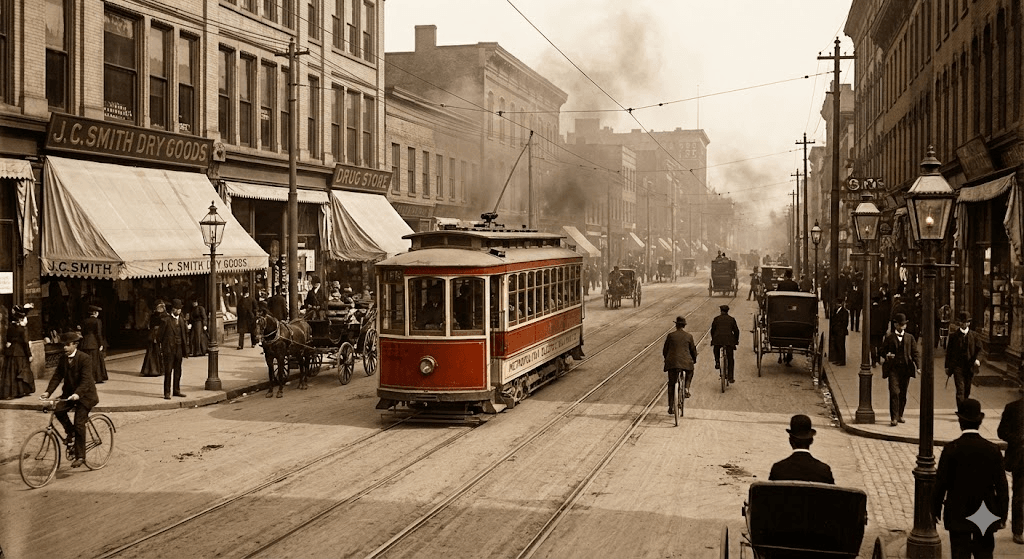
In 1888, the introduction of the electric streetcar revolutionized urban mobility, making movement predictable, affordable, and scalable.
For cities like Denver, navigating growth and geography, this innovation was transformative.
Denver's development has always been influenced by its terrain and expansion patterns.
As the city expanded outward from its core, reliable mobility became essential.
The electric streetcar demonstrated that cities could grow without fragmentation, provided that people remained connected.
These streetcars enhanced daily life efficiency.
Workers could commute consistently, and neighborhoods could develop farther from commercial centers without losing access.
Time became a resource that could be planned rather than endured.
For Denver, this logic proved foundational.
Urban growth here has long depended on infrastructure that transforms distance into opportunity.
Transportation wasn't just about getting somewhere—it was about enabling participation.
The streetcar also introduced a new kind of equity into urban life.
Access to jobs, services, and social spaces expanded alongside transit lines.
Cities became more inclusive simply by making movement easier.
Denver continues to reflect that lesson today.
Conversations around transit, walkability, and urban design echo the same truth revealed in 1888: cities function best when mobility is shared, reliable, and intentional.
The electric streetcar didn't just move people; it reorganized urban possibility.
Denver's growth story is inseparable from that insight—where infrastructure enables connection, and connection enables progress.
Building upon this legacy, Denver is now embracing modern transportation innovations.
In October 2024, the city broke ground on the East Colfax Avenue Bus Rapid Transit (BRT) project, aiming to transform one of Denver's busiest corridors into a high-capacity, efficient transit spine.
This $300 million project will feature dedicated bus lanes, enhanced stations, and improved pedestrian and bike connections, reducing transit travel times by 15 to 30 minutes and increasing access to over 250,000 jobs and community services along the corridor.
Additionally, Denver is planning two more BRT lines along Federal Boulevard and Colorado Boulevard, with construction expected to begin in the coming years.
These projects reflect Denver's ongoing commitment to accessible infrastructure and transportation innovation, ensuring that the city's growth remains connected and inclusive.
As Denver continues to evolve, the lessons from its electric streetcar era remain relevant, guiding the city's approach to urban mobility and public transit evolution. |
0 Comments
Join the conversation
Be the first to comment
Share your thoughts above.